XISTA Fellow in Portrait
Some founders start with an idea. Others start with a problem they have seen again and again.
For Alexander Pekarsky, it was the latter. Over the past years, he has worked across academia and industry on bioprocesses for producing biomolecules. His projects ranged from recombinant protein production to commercial mRNA vaccine manufacturing and large-scale cell-free DNA synthesis. Along the way, he learned what matters, what fails, and what the industry truly needs: reliable, robust biology that de-risks and accelerates production scale-up – regardless of the biology used.
Recently, researchers at ISTA achieved something remarkable: They drastically slowed down bacterial evolution without affecting growth and filed a patent for the technology. ISTA had the idea, the data, and the IP. What was missing was someone who could see the bigger picture and take the challenge of turning it into a venture.
By chance, the researchers and Alexander connected. He immediately realized the potential to improve bacterial production.
Bacteria are widely used in industry, but their ability to rapidly adapt through DNA changes introduces uncertainty during process development and scale-up. This evolutionary drive has also hindered the adoption of continuous biomanufacturing, which if possible, would enable a paradigm shift that could boost yields, reduce costs, and make production more consistent and sustainable.
But transforming a basic research insight into industry-ready data and a viable product is complex, time-consuming, and expensive. This is where XISTA entered the picture.
Through the XISTA Fellowship, Alexander gained access to the ISTA technology and the support needed to explore its commercial potential with the goal of founding an ISTA spin-off. The Fellowship gives scientists one year to turn promising research into a real venture path. It offers time, focus, entrepreneurial guidance, and a direct bridge between science and the market.
And for Alexander, one relationship made a particular difference:“I knew the potential, but I needed the right environment to further develop and validate the solution. The Fellowship has been giving me space, structure, and access to the ISTA technology that is becoming BetterStrains. Working with Prudence Donovan, XISTA’s Innovation Lead for Life Sciences, has been crucial as well. She challenges my assumptions, opens doors, and introduces me to people I would never have reached alone. Her support has been shaping the way this venture is growing.”
This is exactly what the XISTA Fellowship is designed to do:
Take strong science, combine it with real-world experience and add guidance from someone who understands how ideas can become companies. The result is a viable path from idea to company and a technology ready to take its next step into the world.
The momentum is already visible:
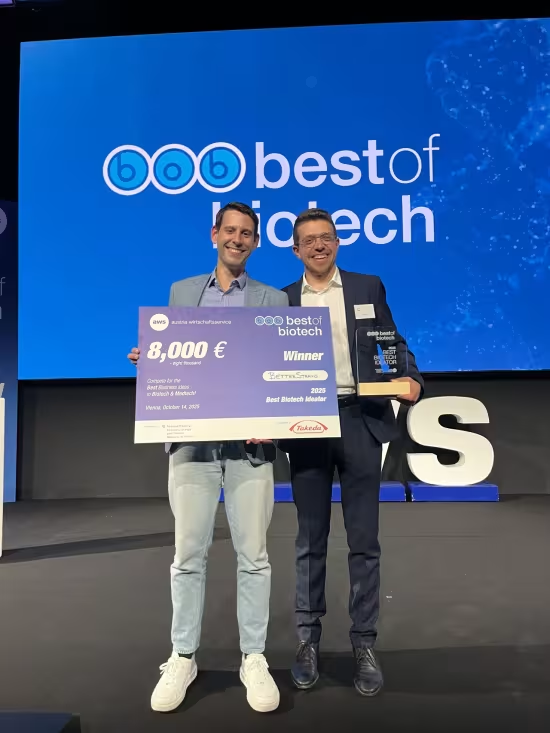
BetterStrains has won the well-known Best of Biotech competition from AWS, reached the finals of Falling Walls Lab Vienna, and made a strong impression at XBIO Demo Day and international conferences. The latest milestone came at BIO Europe, one of the largest partnering events in global biotech, where thousands of companies explore collaborations and emerging technologies. BIO Europe put BetterStrains on the map. Now comes the real work: turning interest into traction, and traction into a company.