The XISTA Science Park is growing
With the opening of the new building, the XISTA Science Park in Klosterneuburg is taking another step in the development of a location where research, entrepreneurship, and financing connect. Located right next to the Institute of Science and Technology Austria (ISTA) and directly connected to the campus via a bridge, an environment is taking shape here where scientific discoveries do not remain isolated but find their way into applications, technologies, and new companies.
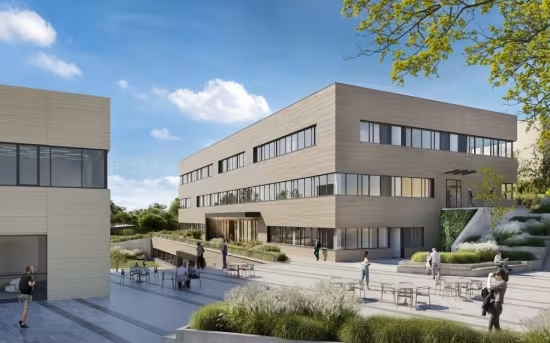
The building, constructed by the Lower Austrian Economic Agency ecoplus, expands the Science Park with modern laboratory, office, and community spaces. The focus is not only on additional capacity but, above all, on the quality of the infrastructure: state-of-the-art scientific facilities for biotech, deep-tech, and other research-oriented companies, combined with flexible office spaces and communal areas for exchange and collaboration. It is precisely this combination of specialized research infrastructure and an entrepreneurial environment that is rarely found in Europe, especially for young scientific spin-offs that need access to professional laboratories and technical infrastructure even in their early stages.
The new building was designed by F+P Architekten in collaboration with Ferro & Partner. The new building complements the existing XISTA Science Park complex with flexible workspaces and laboratory areas that are specifically designed to facilitate interdisciplinary collaboration. This not only expands the site itself but also enhances the ability to develop scientific ideas more quickly and translate them into marketable applications.
“What we see today is the result of many years of groundwork. Our goal has always been to bring research into practical application more quickly with the right infrastructure and an environment that fosters entrepreneurship. With the new building, we are taking the next step in exactly this direction.” says Markus Wanko, Managing Director of XISTA
The immediate proximity to the ISTA campus remains a central component of the concept. At ISTA, international research groups conduct basic research in the natural sciences, mathematics, and computer science. The Science Park expands this environment by providing the infrastructure necessary to further develop scientific findings and translate them into concrete applications. Research, startup creation, and technological implementation do not occur in isolation here, but through daily interaction physically connected by the bridge between the campus and the Science Park.
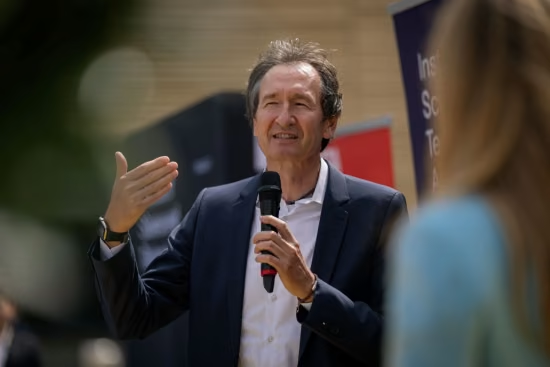
“Translating scientific findings into concrete applications and successful startups has been a central part of our mission since ISTA’s founding. With XISTA Innovation, we have built a bridge between cutting-edge research and commercial implementation. We support our researchers in patenting their ideas and developing them into successful startups,” says Martin Hetzer, President of ISTA.
At the same time, an environment is emerging here that is rarely found in this combination: an international campus atmosphere, specialized research infrastructure, and direct proximity to cutting-edge research, all nestled in a green setting with good public transportation links to Vienna. The location combines focused scientific work with the short distances and informal encounters that are often crucial for the emergence of new ideas.
A visible expression of this idea is the XISTA "Playground" in the center of the campus. Located between the buildings, this space was deliberately created to facilitate encounters outside the lab and office. Shaded seating areas, open gathering spaces, and seasonal plantings create an atmosphere where conversations can arise spontaneously, between researchers, founders, investors, and international guests. The "Playground" is thus part of the concept behind the entire site: innovation often arises where people meet each other unexpectedly.
With this expansion, the XISTA Science Park is increasingly opening up beyond ISTA. In addition to research spin-offs, the offerings are increasingly aimed at science entrepreneurs from Vienna and across Europe who are seeking access to scientific infrastructure, an international research environment, and a growing innovation network.
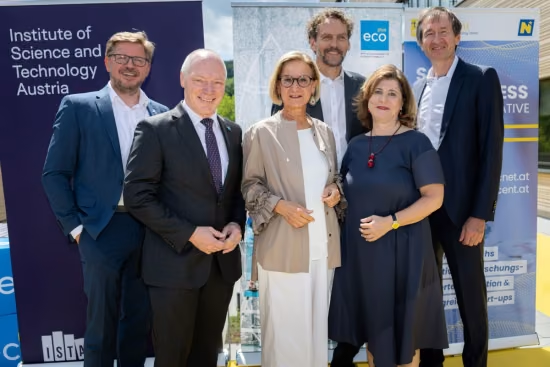
The opening ceremony also highlighted the role the site now plays in the European innovation landscape. In addition to representatives from academia and the business community, attendees included Uli Grabenwarter from the European Investment Fund (EIF), Helmut Miernicki, Martin Hetzer, Doris Agneter, and Governor Johanna Mikl-Leitner. The EIF is one of the most important European players in the field of innovation and growth financing and is, among other things, an anchor investor in the XISTA Science Ventures Fund II.
"EIF's commitment to XISTA Science Ventures Fund II reflects our confidence in XISTA's close integration with leading research environments and, that its long-term approach to deep tech, exactly what Europe's innovation ecoystem needs", says Uli Grabenwarter, Deputy Director, Equity Investments at European Investment Fund.
The expansion of the XISTA Science Park marks another step in the development of a location where innovation does not arise in isolation, but through exchange and is close to science, close to research, and close to implementation.
About XISTA
XISTA is the deep tech innovation ecosystem centered around the Institute of Science and Technology Austria (ISTA). Its goal is to translate excellent research into societal and economic impact. XISTA provides support through awareness programs, entrepreneurship training, consulting, fellowships, and industry collaborations. The ecosystem is complemented by infrastructure offerings at the XISTA Science Park and the venture arm, XISTA Science Ventures. In this way, XISTA supports science-based innovations from concept to implementation. www.xista.com
About ISTA
The Institute of Science and Technology Austria (ISTA) is a PhD-granting research institution located in Klosterneuburg, 18 km from the center of Vienna, Austria. ISTA employs professors on a tenure-track model, post-doctoral researchers and PhD students. The Graduate School of ISTA offers fully funded PhD positions to highly qualified candidates with a Bachelor’s or Master’s degree in biology, mathematics, computer science, physics, chemistry, and related areas. The institute currently has around 90 research groups and 1,300 employees. By 2036, it is expected to grow to 150 groups and over 2,000 employees. While dedicated to the principle of curiosity-driven research, ISTA also aims to deliver scientific findings to society through technological transfer and science education. www.ista.ac.at